Markets rally as tariff relief lifts sentiment
Global markets posted strong gains in May, shaking off a turbulent April as easing trade tensions and resilient earnings helped restore investor confidence. A temporary truce in the US-China trade dispute, alongside solid corporate earnings, offered markets a reprieve from the policy-driven volatility that has dominated 2025.
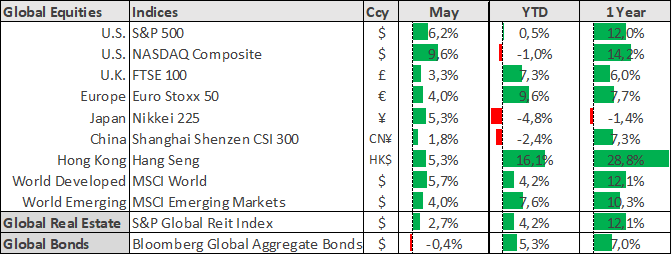
The S&P 500 rose 6.2% for the month, while the tech-heavy Nasdaq Composite jumped 9.6%, its best monthly performance since November 2023. After weeks of uncertainty, the Trump administration announced that the US and China would roll back tariffs significantly over a three-month negotiation window. US tariffs on Chinese goods were reduced from 145% to 30%, while China lowered duties from 125% to 10%. The move was widely welcomed by markets as a sign that cooler heads may yet prevail.
Meanwhile, the US House of Representatives passed a sweeping tax and spending bill backed by President Trump. The bill extends tax cuts from Trump’s first term while increasing defence and immigration funding. The Congressional Budget Office estimates the legislation will add $3.8 trillion to US national debt over the next decade, raising alarm bells across credit markets. Long-term bond yields spiked in response, with the US 30-year Treasury yield hitting a multi-year high.
Moody’s downgraded the US sovereign credit rating from Aaa to Aa1, citing unsustainable fiscal dynamics and rising debt burdens. Despite the downgrade, US Treasury Secretary Scott Bessent dismissed the move as a “lagging indicator,” blaming elevated debt levels on the previous administration. He reaffirmed the administration’s commitment to reducing spending and driving growth through reforms.
The fiscal risks come at a time when the Federal Reserve is facing a more complex policy landscape. Fed Chair Jerome Powell stated that the central bank is in no rush to cut interest rates, citing heightened risks of both inflation and unemployment due to supply-side disruptions, tariffs, and geopolitical uncertainty. The Fed held rates steady in May, and the message from the Federal Open Market Committee (FOMC) was clear: while inflation has moderated, it remains too soon to ease.
European markets made solid gains for the month despite President Trump threatening to impose a 50% tariff on European imports. The Euro Stoxx 50 advanced 4.0% while the FTSE 100 added 3.3%. European equities have gained favour with investors this year as resilient corporate earnings, attractive valuations and Germany’s historic fiscal spending plans boosted regional sentiment.
In Asia, equity markets rebounded as the tariff relief boosted optimism. The CSI 300 Index rose 1.8% while Hong Kong’s Hang Seng Index gained 5.3%. Japan’s Nikkei 225 rose 5.3% despite concerns over the adverse impact of US tariffs on the country’s economy.
In the commodity space, gold remained resilient as investors sought protection from inflation, geopolitical shocks, and currency volatility. Crude oil prices, however, remained under pressure amid concerns over weakening global demand and rising OPEC+ output.
Looking ahead, investors will be watching closely for signs that the US-China truce holds, as well as any potential escalation in trade rhetoric with Europe. Fiscal risks remain a key overhang for US markets, particularly as bond markets begin to reprice long-term debt sustainability. At the same time, earnings have proven more robust than expected, and equity valuations, particularly outside the US, continue to look attractive in a global context.
GLOBAL INDICATORS: Local reporting currencies